
In the race toward developing human-like artificial intelligence, Google’s Gemini 2.5 Deep Think marks a bold new direction. Released on August 1, 2025, for Google AI Ultra subscribers, this advanced mode offers more than incremental improvements—it redefines how AI thinks.
Gemini 2.5 Deep Think employs parallel reasoning to explore, evaluate, and refine multiple solutions—ensuring the most optimal outcome, not just a single guess. This unique capability positions it as a breakthrough for developers, researchers, and professionals facing high-stakes, multi-variable problems.
What is Gemini 2.5 Deep Think?
Gemini 2.5 Deep Think is not just a “slower” version of Google’s Gemini 2.5 Pro—it’s smarter, deeper, and more strategic. It introduces a new problem-solving paradigm where AI mimics expert-level brainstorming.
Instead of following a single line of logic, it simulates multiple simultaneous thought processes. This innovation is made possible by parallel thinking, an advanced cognitive framework inspired by human group ideation sessions. Imagine several expert minds working concurrently on a problem—this is the model Deep Think aims to replicate.
How Gemini 2.5 Deep Think Works: The Power of Parallel Thinking
1. Hypothesis Generation
The AI generates a spectrum of potential solutions instead of focusing on one. Each stream represents a distinct thought process or methodology.
2. Simultaneous Evaluation
Using enhanced compute time, all solution paths are evaluated in parallel, examining their merits, trade-offs, and feasibility.
3. Revision and Combination
Promising ideas may be merged or modified. For example, a viable algorithm from one hypothesis might be blended with an efficient structure from another.
4. Synthesis
The final response is not only accurate but robust, nuanced, and often innovative—the product of multiple cognitive paths converging into one optimized solution.
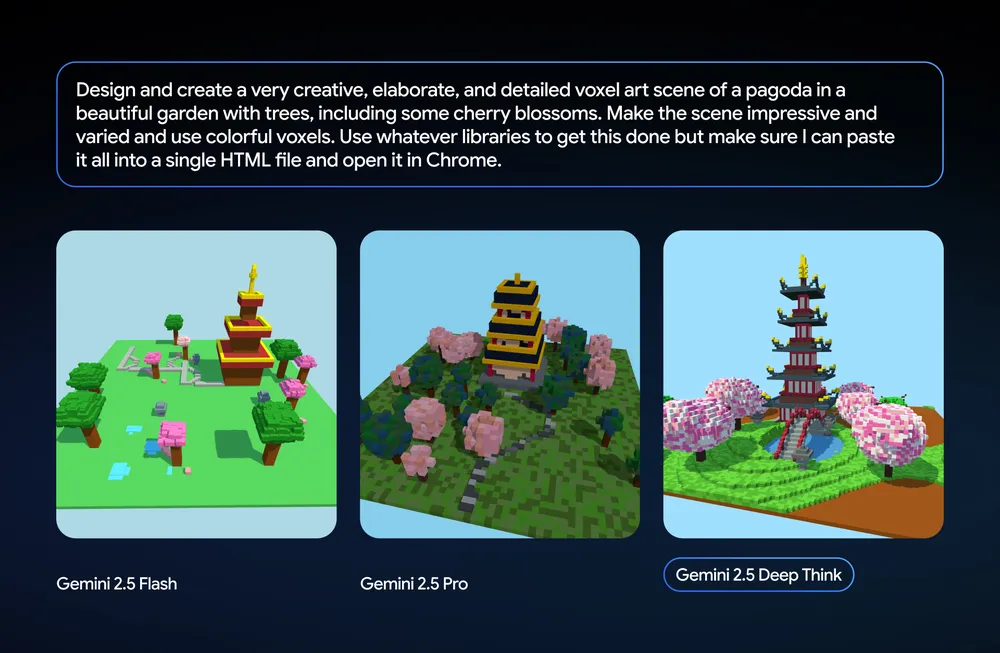
Why Deep Think Matters: Use Cases & Real-World Performance
For Developers: Tackling Complex Code Challenges
Gemini 2.5 Deep Think shines in scenarios where logical intricacies matter—like competitive programming, API architecture, and system optimization.
Example: On the LiveCodeBench benchmark, which measures AI’s performance in solving real-world coding problems, Deep Think reached an impressive 87.6% accuracy, a notable jump from its earlier 80.4% score in May 2025.
Practical Use: Developers can prompt it to:
- Generate optimized code for high-load applications
- Improve existing codebases through iterative enhancements
- Suggest design alternatives based on speed, memory use, and modularity
For Academics and Researchers: From Theory to Breakthrough
In scientific research, Deep Think is revolutionary. It can explore mathematical conjectures, synthesize research papers, or even formulate experimental designs.
Noteworthy Achievement: In testing aligned with the International Mathematical Olympiad (IMO) 2025, the public version of Deep Think earned bronze-level results, while a special research-only version reached gold-level, albeit with much longer processing times.
Use cases include:
- Hypothesis testing in quantum mechanics
- Synthesis of literature reviews for PhD candidates
- Designing complex simulations in biology or physics
For Designers and Product Teams: Innovation at the Core
When used in design thinking, Deep Think doesn’t just suggest layouts—it offers strategic, iterative refinements that blend aesthetics with functionality.
For example, it can:
- Recommend UX flow based on user personas
- Suggest dynamic front-end frameworks
- Offer brand-aligned color schemes with psychological reasoning
How to Use Gemini 2.5 Deep Think: A Strategic Guide
To fully leverage Deep Think, you need to prompt it intentionally. Here’s how:
Define Context & Constraints
Avoid vague prompts. Instead, provide context and define quality standards.
- Example: “Design a finance dashboard for mobile that uses minimal color, must load under 1s, and supports dark mode.”
Encourage Iteration
Ask the AI to build progressively, not just produce final answers.
- Example: “Start by outlining a Python script for scraping financial data. Then add data cleaning steps. Next, visualize it with Plotly.”
Request Alternatives & Justification
Challenge the model to reflect on its choices.
- Example: “What other ML models could solve this classification task, and why did you choose Random Forest?”
Security & Performance Considerations
Improved Security Filters
Deep Think integrates more conservative content filters, reducing the risk of hallucinated or inappropriate content. However, users may experience more benign refusals—even for safe queries—as a trade-off for deeper safety assurance.
Performance Metrics
- LiveCodeBench: 87.6%
- IMO Bronze (public version)
- Aesthetic Design Tasks (internal beta): Over 90% satisfaction from human testers
Resource Management
Due to the intense computing demands, usage is initially limited to a few prompts per day per user.
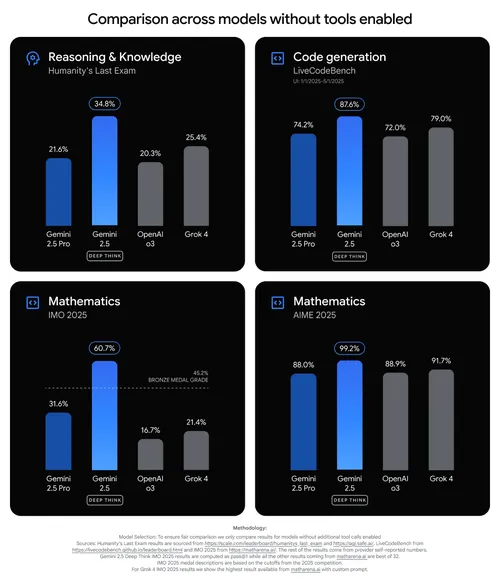
Image Source: Google
Pricing and Access
- Subscription Required: Gemini 2.5 Deep Think is available exclusively to Google AI Ultra subscribers.
- Pricing: $249.99/month (US)
- Platforms: Accessible via the Gemini app (web and mobile)
- Activation: Enable “Deep Think” in the 2.5 Pro dropdown settings
Enterprise API access is currently limited to select partners, with broader availability expected in Q4 2025.
Gemini 2.5 Deep Think vs. Gemini 2.5 Pro: What’s the Difference?
| Feature | Gemini 2.5 Pro | Gemini 2.5 Deep Think |
| Processing Time | Fast | Slower (deliberate) |
| Thought Process | Linear | Parallel |
| suitable Use Case | Quick queries | Complex, multi-variable problems |
| Customization | Limited | Highly iterative |
| Creativity | Moderate | High |
| Cost | Included in Pro | Only with AI Ultra |
A Paradigm Shift in AI Thinking
Gemini 2.5 Deep Think isn’t designed to replace everyday AI interactions—it’s meant to elevate them. Its focus on deliberate, high-fidelity problem solving makes it ideal for users dealing with strategic, scientific, or creative complexity.
With parallel thinking, iterative evaluation, and adaptive synthesis, it acts more like a thought partner than a chatbot. It’s a clear step forward in bridging the gap between human cognition and artificial intelligence.
Final Thoughts
Google’s Gemini 2.5 Deep Think isn’t just a product—it’s a philosophy shift in AI design. By prioritizing depth over speed, and thoughtfulness over flash, it represents the future of collaborative intelligence.
For professionals dealing with high-stakes problems in code, research, design, or strategy, Deep Think provides not just solutions—but insightful, contextual, and adaptive thinking. As AI transitions from assistant to partner, Deep Think is a glimpse into that powerful future.
FAQs
What is Gemini 2.5 Deep Think?
A specialized mode of Gemini 2.5 Pro that uses parallel thinking to solve complex problems through longer, more strategic thought cycles.
How do I enable it?
Via the “Deep Think” toggle in the Gemini app when using the 2.5 Pro model. Available only to AI Ultra subscribers.
What does it cost?
Included in the $249.99/month AI Ultra plan. No extra fee per query, but daily usage is limited.
Is it better than the competition?
For high-difficulty tasks like algorithm design or scientific synthesis, Deep Think offers higher-quality solutions than most commercially available models.
Is there a public research API?
Not yet. Enterprise and academic access is by invitation only, though broader rollout is expected later in 2025.